
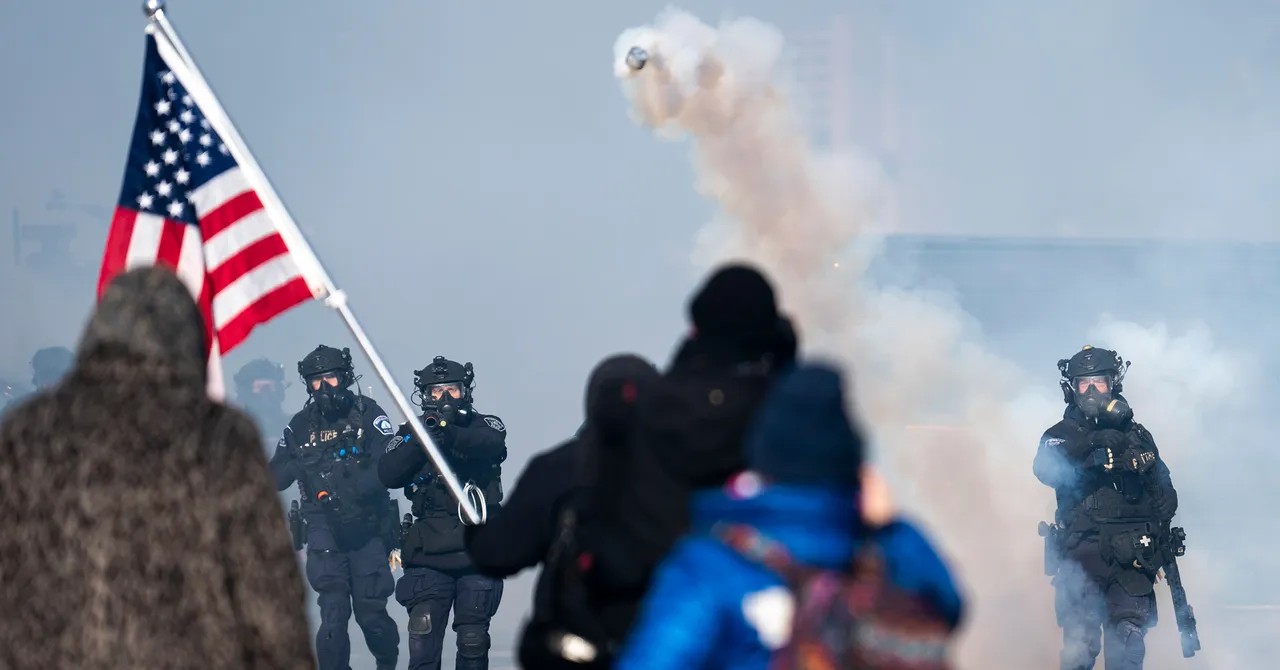
The situation in Minneapolis represents an unprecedented escalation of federal authority, with thousands of masked federal officers operating with questionable jurisdiction, assaulting civilians, and provoking confrontations – all against the explicit wishes of local and state leaders. This is not merely a law enforcement operation; it’s a deliberate act of political coercion by the Trump administration, testing the limits of federal power over state sovereignty.
The Killing of Alex Pretti and Escalating Violence
The fatal shooting of 37-year-old nurse Alex Pretti by federal agents highlights the recklessness of this intervention. This was the second instance this month where federal forces resorted to deadly force within seconds of engaging civilians who posed no threat. This pattern of aggressive behavior raises a critical question: why can’t Minnesota officials effectively stop this?
The answer lies in the fundamental structure of American federalism. While Minneapolis Mayor Jacob Frey and Governor Tim Walz have repeatedly requested President Trump to withdraw the roughly 3,000 immigration officers – exceeding the combined forces of the region’s ten largest police departments – state governments lack the direct authority to expel federal law enforcement. The federal government is, in theory, the ultimate protector of citizens’ rights when local officials fail. However, Trump is weaponizing this principle to punish political opponents, an act that undermines the very foundations of the union.
The Limits of State Resistance
Despite mounting tensions, with local police condemning the shootings of Pretti and Renee Nicole Good, state officials are constrained by legal realities. The governor’s activation of the National Guard is not a direct challenge to federal authority but rather a buffer to mitigate violence. Walz’s approach is cautious, recognizing that overt resistance could trigger an even more severe federal response.
Currently, Minnesota is pursuing legal remedies, including a temporary restraining order to preserve evidence and a broader lawsuit to halt the deployments. This restraint is not weakness; it’s a calculated attempt to avoid further escalation, given Trump’s apparent eagerness to declare “insurrection” and deploy federal troops.
The Threat of the Insurrection Act
Trump has already initiated criminal investigations against Walz and Frey, creating pretexts for invoking the Insurrection Act. This would allow him to deploy federal troops against the state’s residents, an action that would bring the US closer to civil conflict than it has been in over a century. The administration’s rhetoric, labeling protesters as “domestic terrorists,” underscores this aggressive intent.
ICE agents are now documenting individuals who record their actions as “domestic terrorists,” further demonstrating the escalation. A disturbing incident in Maine illustrates this: an ICE officer joked about entering civilian recordings into a national database. This highlights the absurdity of the operation, which has little to do with immigration or crime but is purely politically motivated.
Historical Precedent: When Federal Troops Were Deployed
The use of federal troops domestically is rare but not unprecedented. From Dwight Eisenhower federalizing the Arkansas National Guard to enforce school integration in 1957 to Lyndon Johnson deploying troops during the 1967 Detroit riots (resulting in civilian deaths, including a 4-year-old girl killed by National Guard fire), history shows the dangers of federal intervention.
However, even these interventions typically occurred when state officials either refused to protect civil rights or were the aggressors themselves. Trump’s actions defy this precedent. He is deploying forces without clear legal justification, solely to exert political pressure.
The Path Forward: Restraint Amidst Chaos
For now, state and local officials are prioritizing legal challenges and de-escalation. The situation is unpredictable, and Trump’s erratic behavior makes it impossible to forecast the coming days. The risk of further escalation is high, with 1,500 federal troops already on standby in Alaska.
While activists demand stronger resistance, caution may be the only viable strategy. Any official confrontation could provide Trump with the excuse he needs to deploy federal troops, worsening the situation for everyone involved.
The current standoff underscores a fundamental crisis: the erosion of federalism under a president willing to disregard constitutional norms. The future of Minnesota, and potentially the nation, depends on navigating this unprecedented moment with restraint and legal rigor.
The situation in Minnesota is not simply a law enforcement issue; it’s a test of American democracy itself.