
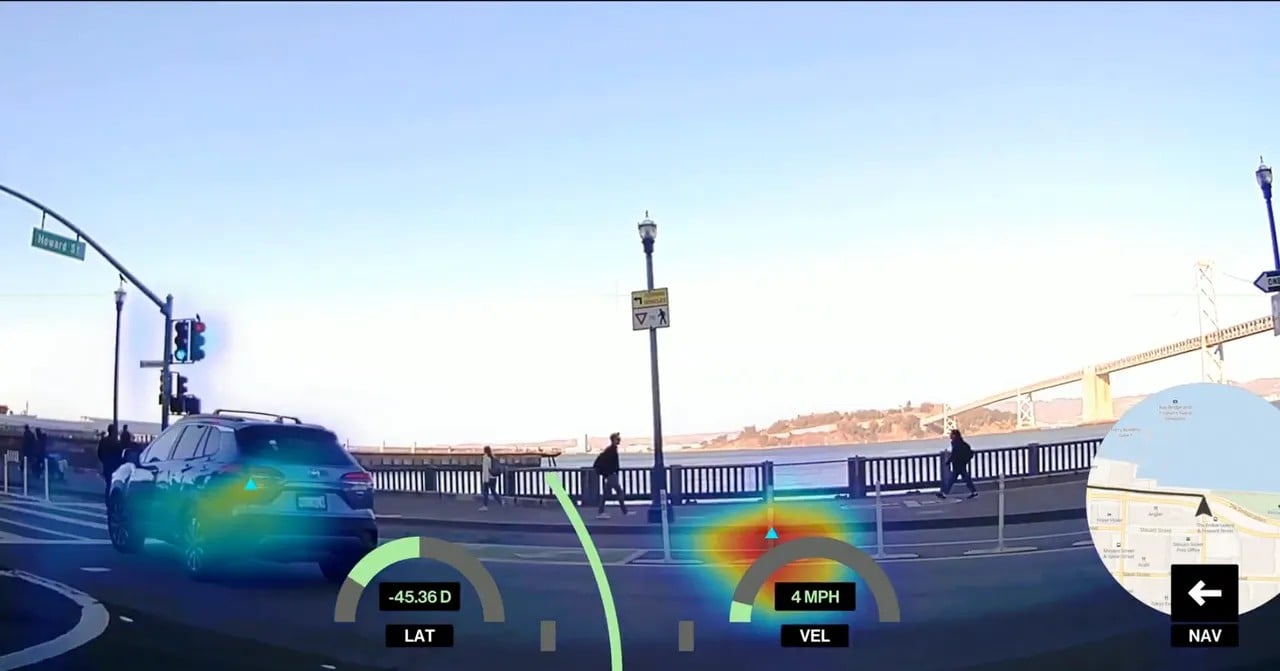
A small startup, HyprLabs, is pushing the boundaries of autonomous vehicle (AV) software development by rapidly training systems using a novel approach. For the past year and a half, the company has been testing its technology in modified Tesla Model 3s around San Francisco, aiming to determine how quickly a company can build reliable AV software today.
The Challenge of Autonomous Vehicle Development
The AV industry has long faced a “trough of disillusionment,” where ambitious timelines were unmet and progress stalled. However, advancements in machine learning are now reducing the cost and human labor required for training self-driving systems. Despite this, achieving truly safe and reliable automation remains a significant hurdle. HyprLabs cofounder Tim Kentley-Klay acknowledges this: “I can’t say to you, hand on heart, that this will work, but what we’ve built is a really solid signal.”
HyprLabs’ Approach: Run-Time Learning
HyprLabs, led by Zoox cofounder Tim Kentley-Klay, is taking a unique approach. The company’s software, called Hyprdrive, aims to streamline AV training. Unlike traditional methods that rely on massive datasets or expensive sensor suites, HyprLabs uses a “run-time learning” technique.
The system uses a transformer model and learns in real-time, guided by human supervisors. Only new and relevant data is sent back to the company for fine-tuning, reducing the computational load. To date, the startup’s two vehicles have collected just 4,000 hours of driving data (approximately 65,000 miles), with only 1,600 hours used for training—significantly less than competitors like Waymo, which has logged over 100 million autonomous miles.
The Evolution of AV Training
For years, the AV industry split between camera-only systems (like Tesla) and those using a combination of sensors (like Waymo and Cruise). Camera-only approaches aimed to save money but relied on vast amounts of data from non-fully-autonomous vehicles. Multi-sensor systems invested in more expensive hardware but used smaller datasets with extensive human labeling. HyprLabs seeks to combine the efficiency of camera-based systems with the precision of labeled data, learning on the job with minimal intervention.
Future Plans: Beyond Cars
While HyprLabs isn’t yet ready for commercial deployment, it plans to license its software to other robotics companies. The company is also developing its own robot—described by Kentley-Klay as “the love child of R2-D2 and Sonic the Hedgehog”—scheduled for release next year. The long-term goal is to create a new category of robots that do not currently exist.
The success of HyprLabs will depend on scaling its technology while ensuring safety and reliability. The startup’s rapid training approach has the potential to disrupt the AV industry, but real-world deployment will require rigorous testing and validation.