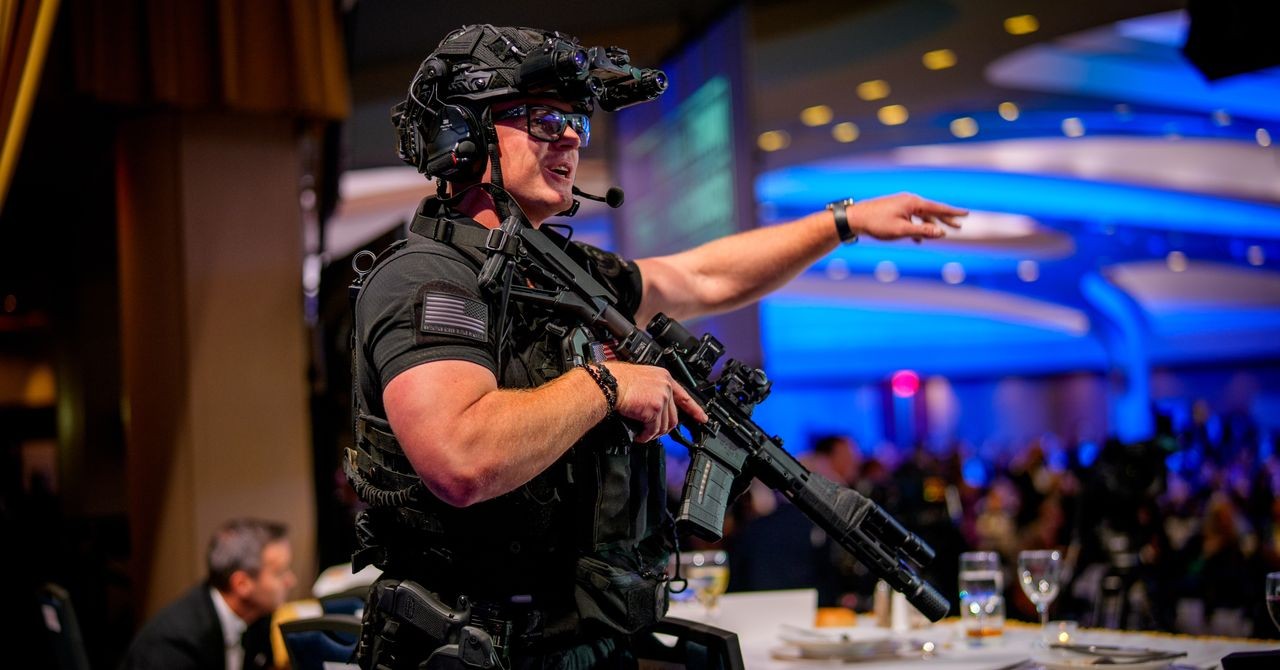
An attack at the White House Correspondents’ Dinner on Saturday night has triggered a massive wave of unverified conspiracy theories across social media. Within hours of the incident, influencers and pundits from across the political spectrum began claiming the event was “staged,” despite a lack of evidence to support such assertions.
The Incident at the Hilton
The disruption occurred at the Hilton hotel in Washington, D.C., where President Donald Trump, Vice President JD Vance, and numerous journalists and administration officials were gathered. According to reports, a suspect identified as Cole Tomas Allen from California allegedly bypassed security and ran toward the event.
Law enforcement moved quickly to evacuate the President and Vice President. While police currently believe Allen acted alone, they have not yet released a specific motive or a confirmed target. However, Acting Attorney General Todd Blanche indicated on NBC’s Meet the Press that officials believe the suspect was specifically targeting administration members.
A Divided Digital Response
The reaction online has been characterized by deep skepticism and “false flag” accusations, coming from both ends of the political aisle:
- On Bluesky: Users, who lean predominantly left, frequently used the term “STAGED,” mirroring the rhetoric seen after the 2024 assassination attempt on Donald Trump in Pennsylvania.
- On X (formerly Twitter): Theories emerged suggesting the attack was a coordinated effort to boost support for a proposed White House ballroom. Proponents of this theory pointed to the President’s subsequent mentions of the ballroom project as “proof” of a pre-planned narrative.
“Evidence” Cited by Skeptics
Conspiracy theorists have latched onto several specific moments to fuel their claims, often recontextualizing mundane or technical occurrences:
- The Fox News Technical Glitch: A clip of Fox News correspondent Aishah Hasnie was widely circulated after her live report was cut off. Users claimed the sudden silence suggested a “preplanned” event. Hasnie later clarified that the interruption was due to poor cellular service and that her husband was simply expressing concern for her safety in a chaotic environment.
- The “Shots Will Be Fired” Comment: Press Secretary Karoline Leavitt had previously mentioned in an interview that “shots will be fired,” referring metaphorically to the jokes expected during the dinner. Following the actual attack, social media users labeled this choice of words as “eerie” or “suspicious.”
- Influencer Amplification: High-profile accounts, including progressive influencer Majid Padellan and various right-wing figures, have used their platforms to pose questions about the event’s legitimacy, often leading to massive, unverified debates in their comment sections.
The Pattern of Rapid Disinformation
The speed at which these theories emerged highlights a growing trend in modern political discourse: the immediate rejection of official narratives in favor of speculative “alternative” truths.
Even prominent figures known for conspiracy-minded rhetoric have struggled to maintain a consistent stance. For instance, Alex Jones shifted from questioning the event’s legitimacy to accepting it within a matter of hours, while Representative Marjorie Taylor Greene has called for further “research” into the suspect without providing concrete leads.
The rapid evolution of these theories—often shifting as quickly as the news cycle—demonstrates how social media platforms can transform a single violent incident into a fragmented landscape of competing, unverified realities.
Conclusion
While law enforcement continues to investigate Cole Tomas Allen’s motives, the digital landscape remains dominated by speculation. The incident underscores the difficulty of establishing a shared factual reality in an era where “staged” becomes a default label for any high-profile political disruption.