
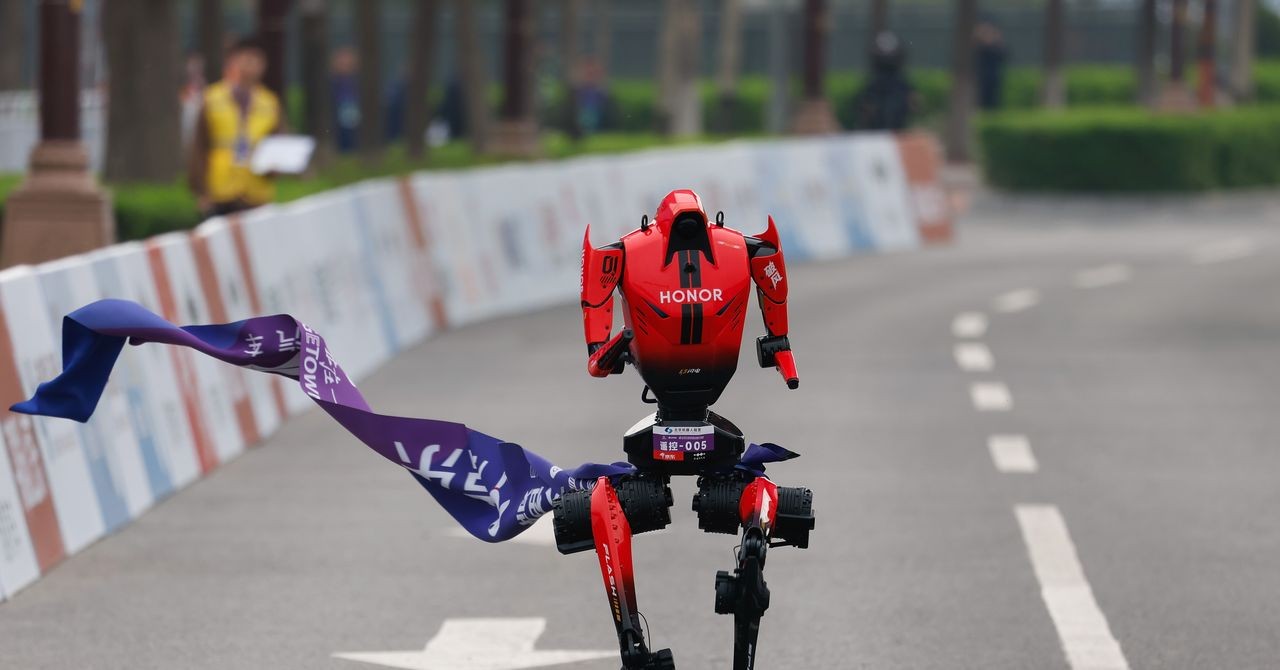
A significant milestone in robotics was reached this past weekend in Beijing, where a humanoid robot completed a half-marathon in a time that would shatter the existing human world record.
Developed by the Chinese technology giant Honor, the robot finished the 13.1-mile course in 50 minutes and 26 seconds. To put this into perspective, the current human world record, held by Olympic medalist Jacob Kiplimo, stands at 57 minutes and 20 seconds. The machine didn’t just beat the record; it outperformed the pinnacle of human endurance by more than seven minutes.
Rapid Technological Evolution
The leap in performance is staggering when viewed through the lens of recent progress. Only one year ago, the fastest robot at a similar event took two and a half hours to complete the same distance. This rapid acceleration highlights how quickly AI and mechanical engineering are converging.
The race in Beijing’s E-Town featured over 100 humanoid robots from 76 different institutions, running alongside 12,000 human athletes on separate, safety-cleared courses. While the Honor robot was a standout, it was not the absolute fastest of the day: a separate Honor model, operated via remote control, clocked in at an even more blistering 48 minutes and 19 seconds.
The Anatomy of a Robotic Runner
The success of the Honor robot is not accidental; it is the result of specific engineering inspired by elite human athletes. Key features include:
– Specialized Morphology: Long legs (nearly one meter) designed for efficient stride length.
– Advanced Stability: Sophisticated balance systems to maintain upright movement.
– Thermal Management: A liquid cooling mechanism, similar to those found in high-end smartphones, to prevent the hardware from overheating under intense physical exertion.
– Autonomous Intelligence: The winning robot operated autonomously, using AI algorithms to adjust its pace and navigate terrain in real time without human intervention.
The Reality of the “Robot Race”
Despite these breakthroughs, the event also highlighted the current limitations of robotics. The race was not without its hiccups; several robots stumbled, veered off course, or required technical assistance to finish.
While the “spectacle” of falling robots has transitioned from being a source of mockery to a moment of genuine scientific interest, a clear gap remains between specialized performance and general reliability. Currently, these machines excel at repetitive, controlled tasks—like running in a straight line—but they still struggle with the unpredictable variables of the real world, such as sudden rain or uneven, unmapped surfaces.
Why This Matters: The Competitive Landscape
This event is more than just a sporting feat; it is a demonstration of China’s strategic push for leadership in advanced robotics. By showcasing machines that can outperform humans in physical endurance, China is signaling its intent to dominate the next frontier of automation.
The achievement raises a profound philosophical and practical question: What happens when machines begin to beat us at our own biological specialties? While we have long accepted that machines (like cars) are faster than us, a humanoid robot—a machine designed to mimic our own form—surpassing our physical limits feels fundamentally different. It moves the conversation from “tools that assist us” to “entities that rival us.”
While robots are currently mastering specific physical tasks under controlled conditions, the true test will be their ability to transition from the track to the complexities of daily human life.
Conclusion
The record-breaking run in Beijing marks a turning point where robotic physical capability officially eclipses human limits in specialized environments. As these machines move from controlled tracks to the unpredictable real world, they will continue to redefine the boundaries between biological and mechanical performance.