
Motorola isn’t just a logo anymore. The brand that once defined American wireless communication has fractured and evolved. In 2011, the original Motorola, Inc. split into two distinct entities: Motorola Solutions and Motorola Mobility. Both trace their lineage back to a small Chicago shop. The headquarters remain in Schaumburg, Illinois. But the story starts much earlier. It starts with two brothers, Paul and Joseph Galvin, who founded Galvin Manufacturing Corporation in 1928.
Their first product wasn’t a smartphone or a walkie-talkie. It was a “battery eliminator.” This device allowed users to plug battery-powered radios into the alternating current outlets that were becoming common in U.S. homes by the early 1930s. At the time, nearly two-thirds of households had access to this power source. The elimination of bulky, expensive batteries was a significant convenience for radio enthusiasts.
By 1930, Galvin expanded into the automotive market. They introduced the “Motorola,” a low-cost car radio. It quickly became the most popular option for new cars and a successful aftermarket kit for existing vehicles. The name stuck. It was catchy. It sounded modern.
The company didn’t stop there. In 1937, they diversified into home tabletop radios. They also introduced the first car radio with push-button dialing. This was a significant innovation at the time. It changed how people interacted with their vehicles.
The early success of Galvin Manufacturing laid the groundwork for decades of innovation. It established a reputation for practical, affordable technology. This foundation allowed the company to pivot later into wireless communications and electronic systems. The transition from battery eliminators to global wireless leader was not immediate. It was a gradual evolution.
The split in 2011 marked a new chapter. Motorola Mobility focused on consumer devices. Motorola Solutions concentrated on public safety and enterprise communication. But the core identity remained rooted in that 1928 Chicago shop. The brothers understood the market before others did. They solved problems people didn’t even know they had yet.
Today, the legacy continues in different forms. The name is still recognized. The history is still relevant. The split didn’t erase the past. It just divided the future.
How Galvin Manufacturing Survived the Depression and Built the First Walkie-Talkie
Galvin Manufacturing didn’t just survive the Great Depression; it got leaner and hungrier. The workforce was slashed by two-thirds. Revenues plummeted by more than a third. The Galvin brothers, vocal opponents of unions, refused to fold. Instead, they took contract work for other firms. One notable client was the Philco Corporation in 1938, a company currently paralyzed by a worker strike.
Defense of this strategy was simple. The Galvins pointed to their payroll. They paid 40 to 60 cents an hour. The industry average sat at 25 to 35 cents. It wasn’t charity. It was a business decision to keep talent and keep the lights on during a global economic collapse.
Then came 1940. The focus shifted to two-way radio communications for police and military use. The first major adoption was an AM-band police radio system. Bowling Green, Kentucky, took the lead that same year. The second product was the Handie-Talkie. It was an AM-band handheld device featuring a long antenna. Soldiers would later carry this into the field during World War II.
Both systems relied on amplitude modulation. That technology was quickly becoming obsolete. Frequency modulation (FM) was superior. It offered clearer transmission. It cut through the noise.
The Invention That Changed Battlefield Communication
In 1943, Galvin Manufacturing invented the FM Walkie-Talkie. This was not just an upgrade. It was a completely different approach to radio communication. The device replaced the clunky AM predecessors with something far more capable.
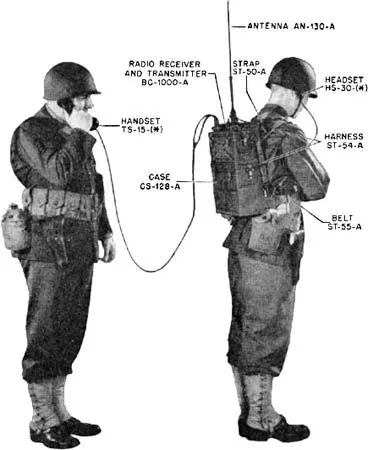
The Motorola Walkie-Talkie Model SCR-300-A stands as a testament to this shift. Designed by Daniel E. Noble, Henry Magnuski, Bill Vogel, Lloyd Morris, and Marion Bond, the unit weighed about 35 pounds (16 kg). Its range hovered around 2 miles (3 km). An illustration from the War Department Technical Manual TM11-242 captures the essence of this early hardware.
Why did this matter? The FM technology eliminated static interference. Soldiers carried these units in special backpacks. The communication was clearer. It was more reliable. The two-way radio saw action on every front during the war. Historians credit it as a decisive factor in many Allied victories.
“The two-way radio saw action on all fronts during the war and is credited as being a decisive factor in many Allied victories in the field.”
The transition from AM to FM wasn’t just technical. It was tactical. Clearer voices meant faster decisions. Faster decisions meant survival. The Walkie-Talkie became indispensable. It allowed commanders to coordinate movements that would have been impossible with static-filled AM lines.
Galvin Manufacturing had pivoted from struggling radio repair to essential military hardware. They had beaten the Depression by paying better wages and taking hard contracts. They had beaten the technological curve by adopting FM. The rest is military history. The device evolved. The weight changed. The range expanded. But the core idea remained the same. Communication under pressure.
The handie-talkie wasn’t just a radio. It was a gateway.
After going public in 1943, Motorola didn’t just sit on its new capital. It rebranded in 1947. The name stuck. By 1948, the strategy shifted from purely industrial gear to living rooms. The golden opportunity was television.
Enter the Golden View.
It cost under $200. That was a fraction of what competitors charged. The design was distinct. A seven-inch round picture tube. Not square. Round. It worked. Motorola captured 10 percent of the U.S. TV market by 1954. That’s a massive slice for a newcomer.
But hardware alone doesn’t build loyalty. You need content.
So they made their own. The Motorola TV Hour launched in 1953. A weekly drama series. Robert Galvin, Paul’s son and vice president, hosted it. He put his face on the screen. He tied the brand to the entertainment experience.
The move was smart. It turned a appliance into an event.
High fidelity followed. Phonographs arrived in the mid-1950s. The consumer line expanded. They weren’t just selling boxes anymore. They were selling a lifestyle.
From Vacuum Tubes to the Semiconductor Boom
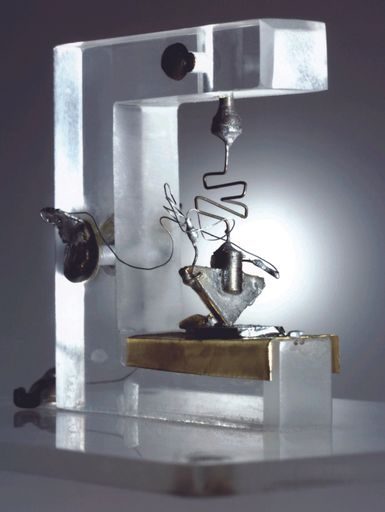
Paul Galvin and his son Robert Galvin led Motorola through a pivotal era. The shift began in 1952. Motorola licensed transistor designs from Bell Laboratories. The goal was simple but difficult: replace heavy, expensive vacuum tube power supplies. The existing equipment was bulky. It cost too much. Transistors offered a way out.
Experimentation took time. By 1956, the strategy changed. Motorola started selling hybrid radios. These devices used both vacuum tubes and transistors. It was their first real success in consumer electronics. But they did not stop there. The same year, Motorola began selling transistors to other manufacturers. They established the Semiconductor Products Division in Phoenix, Arizona. This marked a formal commitment to the new technology.
The pace accelerated. In six years, the company expanded its catalog significantly. By 1962, Motorola had over 4,000 different electronic components on the market. The automotive industry became a massive early adopter. Car makers needed to replace generators. Alternators were more efficient. Motorola supplied the components to make this swap possible. Most cars sold in the 1960s used these new systems.
The partnership did not end with electrical parts. In 1965, the landscape of car audio shifted again. Motorola joined forces with Ford Motor Company and the Radio Corporation of America (RCA). They developed the eight-track tape player. This device would define in-car entertainment for a generation. The move from heavy radio supplies to compact semiconductors and digital storage showed where the future lay. The foundation was set. The rest of the industry had to catch up.
Innovation often looks like a straight line. It isn’t. It’s a jagged mess of wrong turns and sudden, terrifying leaps into the unknown.
Take Motorola. You know the name. Razors. Brick phones. The logo that looked like a spinning wheel. But before it was a household name for gadgets, it was something else entirely. Something louder. Something that reached for the stars when most companies were still fighting over car radios.
It started with a shift in leadership. Robert Galvin took the reins in 1956.
He looked at the company’s strong brand in consumer electronics and saw a ceiling. It was good money. Safe money. But Galvin wasn’t interested in safe. He wanted government contracts. He wanted business-to-business dominance. It was a risky pivot. Consumer brands don’t usually become industrial giants overnight. But Galvin pushed.
The result? Motorola didn’t just supply radios. They helped humanity leave the atmosphere.
In 1962, they began supplying radio communications gear to the Mariner program. Those were unmanned probes, yes. But they were the first steps into the void. Then came the manned Gemini missions. The stakes went up. The margin for error went down to zero.
“The company didn’t just build radios. They built the voice of exploration.”
The climax arrived in 1969. Apollo 11. Neil Armstrong. The Moon.
When Armstrong stepped onto the surface, his voice didn’t travel on its own. It rode a Motorola-designed transponder. The signal that carried “one small step” back to Earth was built by the same company that once made car radios.
It’s a reminder of how fragile these corporate histories are. One executive’s vision can redirect an entire company’s DNA. From consumer goods to space-age infrastructure. It wasn’t about marketing redirection in the traditional sense. It was about survival through scale. And for a brief, bright moment, Motorola was the bridge between Earth and the sky.
But the 1970s were coming. And the space race would cool. The money would dry up. And the company would have to find a new way to survive the silence.
From Car Phones to the PowerPC
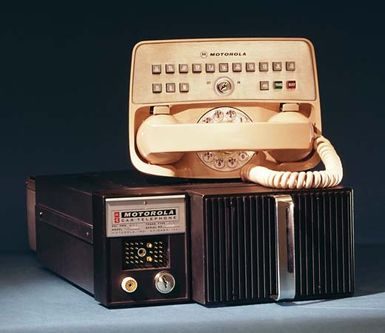
The era of car phones began in earnest with Motorola’s Improved Mobile Telephone Service (IMTS) system in 1964. It was a bulky affair. The setup included a base unit, a control head with a handset, and push-button dialing. You didn’t just carry the phone. You installed it.
Consumer electronics changed trajectory in 1974. Motorola sold its Quasar television line to Matsushita Electrical Industrial Co., Ltd., effectively ending most of its historic consumer hardware business. That same year marked a pivot toward silicon. The company released its first microprocessor for sale to computer makers.
The MC680x0 series became the workhorse. These chips powered early Apple Macintosh computers. They also ran workstations built by Sun Microsystems and Silicon Graphics throughout the 1980s and early ’90s.
In 1993, the stakes got higher. Motorola partnered with IBM and Apple to develop the PowerPC. It was the first consumer RISC (reduced-instruction-set computing) chip. The goal was specific: unseat Intel Corporation as the leading seller of microprocessors. The attempt failed. Intel held the line.
But Motorola found its footing elsewhere. Embedded microprocessors became ubiquitous. Automotive control units relied on them. Industrial systems needed them. Kitchen appliances used them. Pagers, electronic game systems, routers, laser printers, and handheld personal digital assistants (PDAs) all depended on this tech. In this market, Motorola became the leading manufacturer.
The Cellular Revolution
Consumer telecommunications shifted again in 1977. Motorola developed a handheld wireless telephone. It communicated with the public telephone network through short-range “cells.”
Adoption accelerated fast. By 1985, most major cities worldwide were installing cellular systems. The hardware evolved to match. In 1989, the company introduced the MicroTAC flip cellular phone. It became an international status symbol. It was also a genuinely useful personal communications device.
The overwhelming success of cellular telephony inspired a more ambitious project: Iridium. This was a system of 66 small satellites deployed in low Earth orbit. The goal was communications over virtually the entire surface of Earth. Iridium linked existing terrestrial systems. Faxes. Pagers. Computers. Telephones. It went operational in 1998.
The technology existed. The coverage was global. But did it make sense for the average user? The market had already moved past pagers. The infrastructure was in place. The service was live. Yet the satellite model struggled to find its footing in a world increasingly wired to the ground.
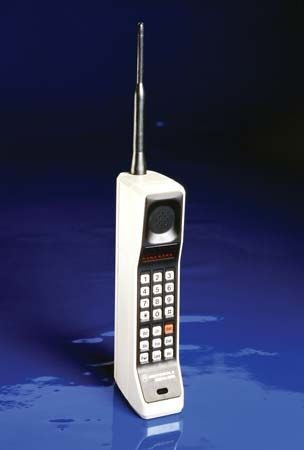
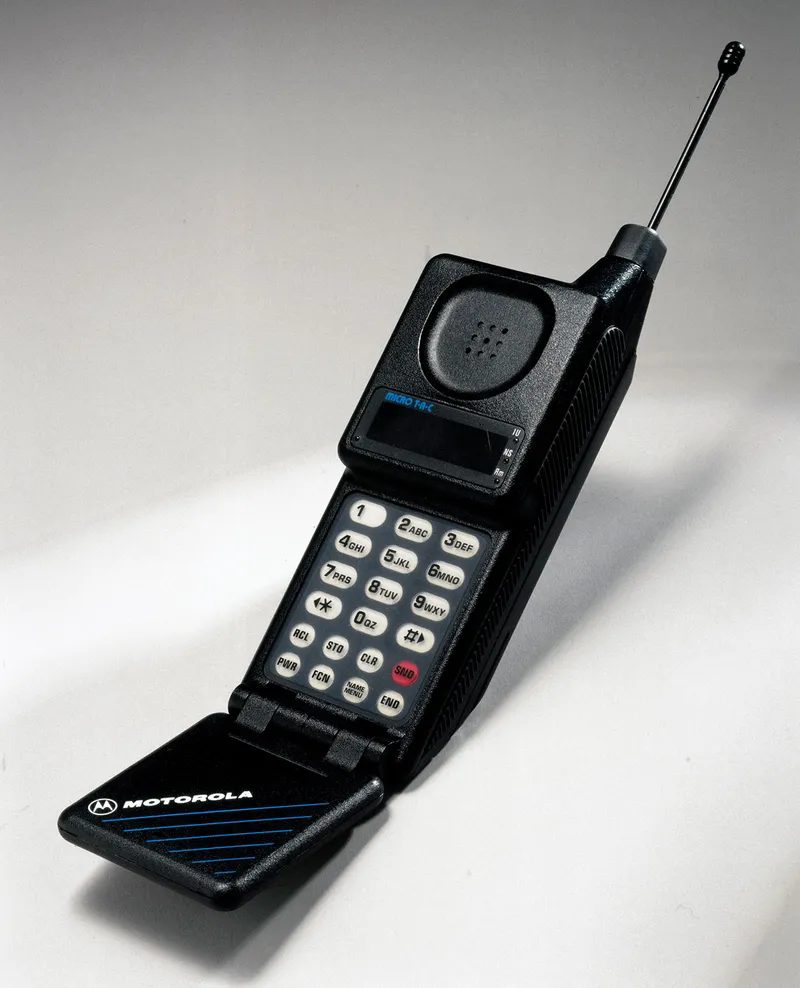
The Motorola DynaTAC 8000X hit the market in 1983. It was the world’s first portable commercial handheld cellular phone. A decade later, the company tried again with the MicroTAC flip phone in 1989. Both were innovations. Both were expensive.
But there was a bigger project in the background. One that burned through cash faster than anyone expected.
Iridium. A network of satellites designed to provide global coverage. The idea was solid. The execution was a disaster. The service cost too much for most users. The technology was ahead of its time. Or behind it. Depending on who you ask.
“The service proved too expensive, however, and Motorola divested itself of its interest in Iridium to limit its liability.”
Losses piled up. Cash flow evaporated. Competition from other cellular manufacturers intensified. Motorola couldn’t keep subsidizing the dream. So it started selling parts of itself.
The Semiconductor Components Group was the first major piece to go. Sold to a private equity group and rebranded as On Semiconductor in 1999. This wasn’t just a sale. It was a survival tactic. The company needed liquidity. It needed to stop bleeding money.
Then came the Integrated Information Systems Group. Built systems for government and defense contractors. Sold to General Dynamics Corporation in 2001. Another chunk of the corporate body cut away to keep the patient alive.
The Semiconductor Products Sector followed. This group made the company’s semiconductors. Including the PowerPC processor. Reorganized as an independent corporation called Freescale Semiconductor, Inc. in 2004. Independence wasn’t a gift. It was a necessity.
Finally, the Embedded Communications Group. Provided services to defense, aerospace, telecommunications, medical imaging, and industrial automation. Sold to Emerson Electric Co. in 2007.
By then, the Motorola of the 1980s was gone. The DynaTAC was a relic. The Iridium network was a cautionary tale. What remained was a company reshaped by necessity. Not by vision.
Did they fail? Or did they survive?
The numbers don’t lie. The cash flow problem was real. The losses were significant. The divestitures were strategic. But was it enough?
Look at the dates. 1999. 2001. 2004. 2007. Four different sales. Four different buyers. Each one a piece of the old Motorola.
Where did the money go? Into the red. Into the satellite network that never quite worked out. Into the competition that ate their lunch.
Is there a lesson here? Maybe. But the lesson isn’t in the headlines. It’s in the balance sheet.

How Motorola’s Split and Acquisitions Reshaped the Mobile Landscape
The DynaTAC 8000X wasn’t just a brick; it was the beginning of an era. But by the 2010s, that legacy was fraying.
Sales of semiconductor businesses helped. The RAZR V3, launched in 2004, was a genuine hit. It improved the bottom line, sure. But it wasn’t enough.
Motorola was bleeding market share. Rivals were eating its lunch. The decline felt inevitable until 2009. That’s when the pivot happened.
The Android Pivot and Corporate Split
Motorola introduced smartphones running Android. This was Google’s operating system. It turned the tide. Sales started climbing again.
But the structure of the company was broken.
In 2011, they pulled the plug on the unified entity. The split created two distinct paths:
- Motorola Mobility: Focused on consumer goods. Smartphones. Tablets. Digital cable boxes. Modems. Home networking.
- Motorola Solutions: Kept the enterprise and government contracts. Two-way radios. Bar code scanners. Computer network assembly.
This division allowed each arm to fight its own battles. Mobility had to compete in the crowded smartphone space. Solutions had to serve specialized markets.
The Google Buyout and Lenovo Acquisition
Google saw value in what remained of the consumer hardware side.
In 2012, Google bought Motorola Mobility for $12.5 billion.
Why? Patents. Google wanted a defensive moat against competitors like Apple and Microsoft. The hardware was secondary to the intellectual property.
But the deal didn’t last.
Google sold Motorola Mobility in 2014. The buyer was Lenovo, a Chinese computer giant. The price? Just $2.91 billion.
A massive write-down.
Yet, Google kept the patents. They licensed them back to Motorola for a fee. The hardware ownership changed hands, but the core legal protections stayed with the search engine.
Lenno received the brand. The factories. The product lines.
Google walked away with security.
It’s a reminder that in tech, assets are liquid. Brands are temporary. Patents are permanent leverage.
The phone in your hand might bear the Motorola name. But the power behind it? That shifted quietly, behind closed doors, for billions of dollars.
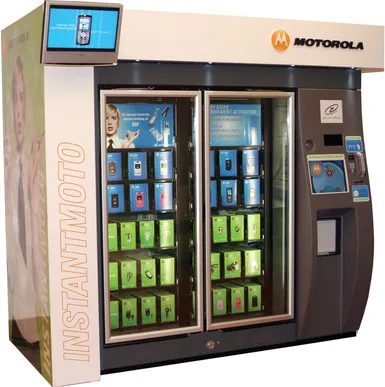
The year was 2007. The world was still reeling from the hype of the original iPhone, which had dropped the previous June. Everyone was talking about touchscreens, app stores, and the death of the physical keyboard. But in the background, while the tech press was obsessed with silicon and software, Motorola was trying to figure out something else entirely.
They didn’t just want to sell phones. They wanted to control the shelf space.
This is where the Motorola INSTANTMOTO mobile-device vending machine enters the story. It wasn’t a sleek glass box like the Apple Store display cases we see today. It was industrial. It was loud. It was 2007.
The Hardware Was a Brute
If you walked into a major retail partner in 2007 and saw this thing, you’d likely ignore it or assume it was broken. The Motorola INSTANTMOTO vending machine was a bulky, gray metal unit. It looked less like a consumer appliance and more like a piece of office furniture that had been put through a shredder and reassembled by an engineer who didn’t care about aesthetics.
Inside, however, was a precise mechanical system. It used a carousel or pusher mechanism to dispense a single unit of a Motorola phone upon payment. The idea was simple: reduce friction. No sales associate needed to fetch a box from the back room. No inventory counting by hand. You put money in, you got a phone.
Why did they build it? Because brick-and-mortar retailers were scared.
Why Retailers Were Panicking
The retail landscape in the mid-2000s was shifting. Traditional electronics chains were losing market share to big-box stores like Walmart and Target. These giants didn’t want to manage complex inventory spreadsheets for every SKUs of every phone model. They wanted simplicity.
Retailers wanted self-service solutions.
They wanted a machine that could sit in the aisle, require minimal staff intervention, and ensure that the phone was always there when the customer wanted it. Motorola, struggling to compete with Nokia’s dominance and the looming threat of Apple, saw this as a way to embed their brand directly into the retail floor.
It wasn’t just about sales. It was about visibility.
The Human Factor Was Ignored
Here’s where the Motorola INSTANTMOTO mobile-device vending machine failed to account for human nature.
People didn’t just want a phone. They wanted to touch it. They wanted to see the screen. They wanted to ask a question. The vending machine stripped away the service layer entirely. It assumed that the product was so desirable, or the price so clear, that no interaction would be needed.
This was a dangerous assumption.
In 2007, smartphones were still a novelty. Most consumers were buying feature phones. These were commodities. If a customer had a question about the battery life, or how to transfer contacts, they needed a human. The vending machine offered none of that. It was a transactional dead end.
The Cost of Innovation
Building and maintaining these units was expensive. Motorola had to manufacture them, distribute them, and support them. Retailers had to allocate space for them. And yet, the uptake was lukewarm at best.
Why? Because the value proposition was weak.
If you could